
Are you writing your resume for your dream job? Talking about how “proficient” you are at something is excellent to include, and many employers love to read it. We’ve included a list of common phrases with “proficient” in your resume at the end of this article if you want to read them!
Otherwise, this article will explore the different prepositions you can use with the word “Proficient.”
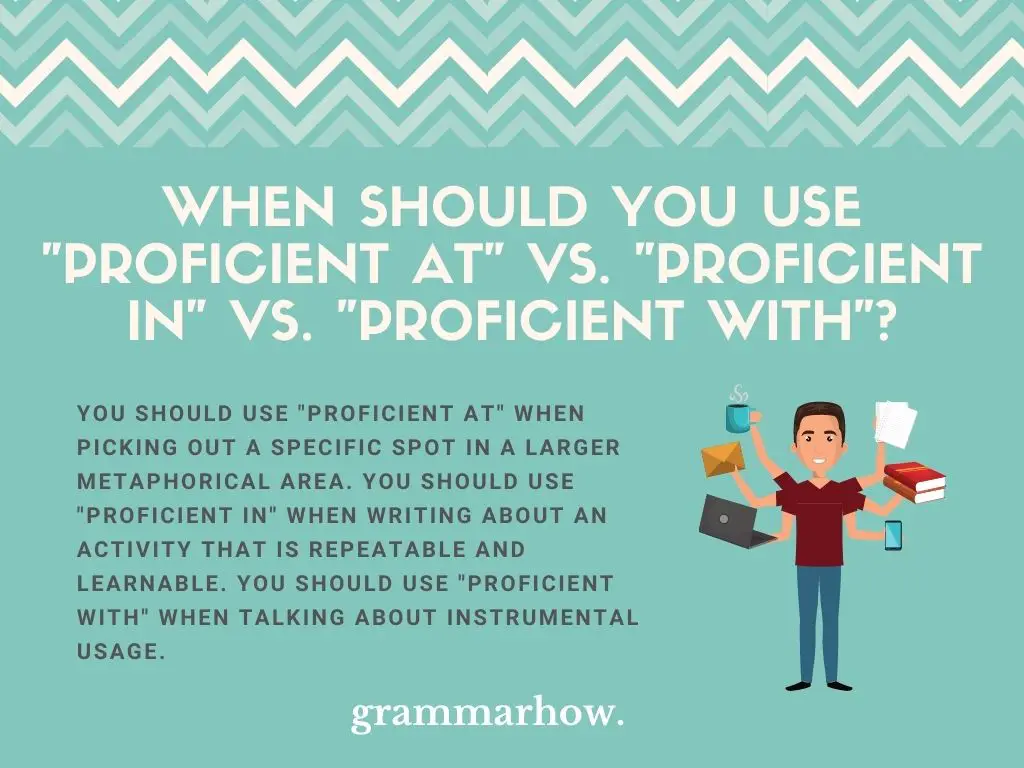
When Should You Use “Proficient At” vs. “Proficient In” vs. “Proficient With”?
You should use “proficient at” when picking out a specific spot in a larger metaphorical area. You should use “proficient in” when writing about an activity that is repeatable and learnable. You should use “proficient with” when talking about instrumental usage.
- I’m proficient at finding my way home every day, no matter where I am.
- I’m proficient in musical theory.
- I’m proficient with Excel.
The definition of “proficient,” according to The Cambridge Dictionary, is “skilled and experienced.”
We pick up “proficiency” with things when we dedicate our time to doing them. As we learn and evolve our abilities, we inevitably become more proficient at certain things.
Many employers like to know what you’re proficient with before you apply for a job. It’s one of the key things they look for when you write your resume. Some people can be hired simply because of a unique proficiency over anything else.
When to use “Proficient At”
Let’s look deeper into each of the prepositions that come with “proficient.”
“Proficient at” refers to picking out a specific thing or being able to pinpoint an exact location in a given area. It can be a literal (physical location) or metaphorical (point in an argument) area.
- I’m proficient at finding the flaws in my teacher’s lessons.
- I’m proficient at making my way home, no matter where I am.
- I’m proficient at being on time every day.
- I’m proficient at thinking on the spot and dominating a debate.
As you can see, “proficient at” refers to a locative expression. That means it’s closely related to the spatial awareness of something, and we can use it to demonstrate such.
It’s not one of the most common prepositions to use, but it still works really well when you find the right place to use it.
When to use “Proficient In”
“Proficient in” is one of the most common prepositions. We use it to talk about any activity or task we’ve spent a lot of time learning about. That task has to be repeatable and learnable, and we have to be experienced with it before we are “Proficient.”
- I’m proficient in musical theatre and the studies surrounding it.
- I’m proficient in language learning and would be happy to teach it to anyone.
- I’m proficient in engineering because of my degree.
- I’m proficient in coding, and I’ve made multiple programs, each with individual identity.
“Proficient in” is a common preposition to use. We use it in the most general sense to refer to activities that we’re talking about. If we’re not referencing a specific object or instrument that we’re working with, then we are “proficient in” the subject.
When to use “Proficient With”
“Proficient with” is another very common preposition to use. It’s common because it relates to specific instruments or tools we use to complete a task. If you reference a name of something, “proficient with” is the one you’ll find most useful.
- I’m proficient with Excel spreadsheets and every formula on them.
- I’m proficient with technology. There isn’t much I don’t know.
- I’m proficient with all applications from the Adobe suite.
- I’m proficient with everything that comes with the Microsoft Office Suite.
As you can see, we typically name something when saying “proficient with.”
When writing “proficient” in a CV or resume, it’s common to talk about specific types of software or applications that we know how to use. It shows that we’re computer-savvy and that we’re able to learn a lot on the job while practicing with software (even if we haven’t used it before).
List of common phrases with “proficient” on your resumé
So, let’s go over some common phrases using “proficient” that you might come across. For each, we want you to pay attention to whether we’re using “at,” “in,” or “with.” That way, you can learn exactly when they’re used.
- I’m proficient with Microsoft Office.
- I’m proficient with Excel.
- I’m proficient with the software.
- I’m proficient with languages.
- I’m proficient with Microsoft Office Suite.
- I’m proficient with Java.
- I’m proficient with Photoshop.
- I’m proficient with technology.
- I’m proficient with Microsoft Word, Excel, and PowerPoint.
- I’m proficient in computer skills.
- I’m proficient in communications skills.
- I’m proficient in coding.
- I’m proficient in English.
- I’m proficient in Chinese.
- I’m proficient in oral and written English.
- I’m proficient at writing and speaking.
We included the common phrases based on the preposition used. As you can see, it is much more likely that you’ll use “proficient with” when you’re namedropping a specific type of software or talking about the instruments you use when completing the task you’re talking about.
An employer will be more than happy to see any of the above phrases in your resumé. Of course, every employee is different, and sometimes none of these will relate to you. If that’s the case, don’t fret! We’re sure there’s something that you’re proficient with that you can include.
These are just the more common ones you’ll come across. If we could analyze every single CV or resumé ever written, we’ll find that the above bullet points are the most likely ones to appear.
Either way, whatever form you’re using or whatever thing you’re proficient with, make sure you know which preposition works best. If you skipped to this section and you’re unsure about which preposition works best, we recommend you look through the rest of the article to find out.
To summarize, “at” is best for a specific area of ability that you have in a larger area. “In” is best in a general sense when you talk about your skills that are repeatable. “With” is best to reference names or talk about the tools you use that you’re proficient with.
You may also like:
10 Good Synonyms For “Proficient” On Your Resumé
Mastery vs. Proficiency vs. Familiarity – When to Use Each